

It may not be a job termination… but nobody leaves until they see results.
Vice City Employment Playbook: What GTA 6’s Handlers Teach Us About Company Size, Loyalty, and Career Betrayal
It’s hard to recall the hundreds of times in my youth when some loosh-farming middle manager or executive archon, that looked like their passion for life was sucked out of them before their soul, tried to look like a mob boss or a CIA interrogator while interrogating me about performance or before a layoff. What is an underappreciated, disenfranchised worker to turn to when they have no negotiating power, a drying up circle of friends and family, and lack of proper direction?
GTA.
Grand Theft Auto VI is, unequivocally, the largest-grossing, most anticipated single piece of media ever in the recorded history of the human race. Buy why? Apart from being able to do almost anything you can think of without real-life repercussions (unless you were literally eating lead paint chips all your life and decided to reenact in-game actions IRL), there is some level or character plight that resonates with us when we play. GTA holds a mirror to how power, labor, and ambition actually operate. Since last week with the launch of GTA VI, millions of players are stepping into the shoes of Jason Duval and Lucia Caminos, two professionals in a relationship trying to build a future in a high-risk economy. They are also trying to get custody of their kid who was taken away after Lucia was arrested for robbing a bank. See? Problems a lot of us have.
Fine, strip away the crime part, and Jason and Lucia’s journey across Leonida is a pure, classic career progression: moving from informal gig work to mid-market boutique firms, and finally into the upper echelons of multinational conglomerates. Along the way, they encounter the exact management archetypes, and betrayal triggers, that modern professionals face at small, mid-sized, and large employers.
Here is what the handlers of GTA 6 reveal about how organizations really run, and how to spot the difference between a good leader who invests in you and an institution that treats you as expendable.
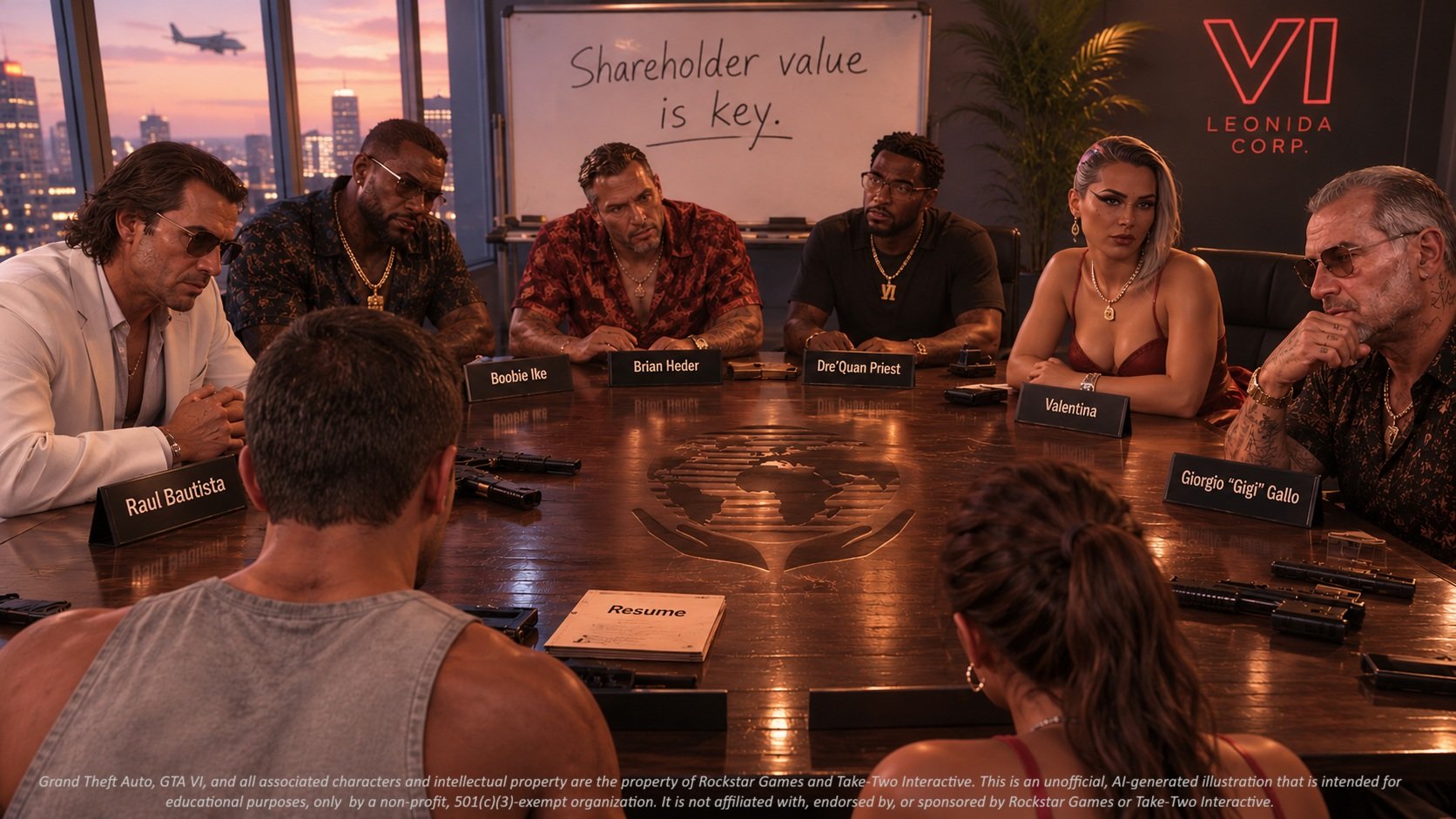
It may not be a job termination… but nobody leaves until they see results.
The Small Business / Family Operation: Brian Heder
The GTA 6 Archetype: Brian Heder runs a legacy smuggling op out of his boatyard in the Leonida Keys. He lets Jason live on one of his properties rent-free, delegates hands-on logistics to a tight inner circle (Jason and Cal Hampton), and operates on personal trust rather than formal contracts. He was stern but forgiving to Donnie Carter, a smuggler pilot on the team, and even mourned him when Donnie was iced and fed to pigs. He called for a memorial over drinks and retired after feeling like his own family was lost in the business dealings.
The Corporate Parallel (Small Businesses & Startups): Small organizations run on proximity, informal perks, and relational loyalty. Like Brian, founders often blur the lines between personal favor and professional compensation ("living rent-free" instead of transparent equity or market pay).
Loyalty vs. Betrayal Diagnostic:
Green Flag: High-trust founders protect their inner circle when external heat rises. Brian never sold his team out and even tried to negotiate to protect a team member (Donnie).
Red Flag: In small operations, lack of formal boundaries can trap employees in indefinite obligation. If your compensation is tied to personal favors rather than clear deliverables, your career growth hits a ceiling the moment the founder retires. You can also see some employees become frustrated with growth rate and go rogue (like Donnie started using the product while flying and got into trouble with the Kingfishers.
The Mid-Sized Growth Company: Boobie Ike & Dre’Quan Priest vs. Raul Bautista
As Jason and Lucia move away from the Keys and enter Vice City, they encounter two distinct models of mid-sized, growth-stage leadership:
Model A: The Ecosystem Builders (Boobie Ike & Dre’Quan Priest)
The GTA 6 Archetype: Boobie Ike transitioned from the streets into legitimate real estate and entertainment (Jack of Hearts), partnering with ambitious operator Dre’Quan Priest to scale Only Raw Records and break artists like Real Dimez. They provide Jason and Lucia with housing and resources in exchange for operational execution and talent protection.
The Corporate Parallel (Scaling Mid-Market Firms): This is the classic visionary-plus-operator leadership duo. They are building legitimate brand equity and need reliable utility players to bridge the gap between street-level execution and executive ambition.
Loyalty vs. Betrayal Diagnostic: Leaders who are actively building long-term institutional legitimacy (like Boobie) have a vested interest in keeping their core team intact. When incentives are aligned around shared growth, mid-sized firms offer the highest upward mobility and lowest rate of backstabbing.
Model B: The High-Risk Project Team (Raul Bautista & Valentina)
The GTA 6 Archetype: Raul Bautista is a charismatic, reckless veteran bank robber constantly chasing the next big score, partnered with Valentina. They assemble specialized strike teams for high-payout jobs, [spoiler alert] that is until Valentina double-crosses both their temporary partners and Raul himself during the Vice City International Airport heist.
The Corporate Parallel (Consultancies, Deal Teams, & Venture-Backed Sprints): Project-based organizations thrive on adrenaline, charisma, and short-term wins. However, when a team's only glue is "the next big score," internal politics turn predatory the moment pressure mounts.
Loyalty vs. Betrayal Diagnostic: Watch the co-leaders, not just the figurehead. Raul remains loyal to his crew, but Valentina’s willingness to sacrifice external contractors (Kordell) is an early warning sign that internal teammates are next. Rule of thumb: If a team casually burns its external vendors or partners, you are next on the list.
The Enterprise Conglomerate: Giorgio "Gigi" Gallo
The GTA 6 Archetype: By the endgame, Jason and Lucia are working for Giorgio "Gigi" Gallo, a billionaire shipping magnate (Bilgeco Shipping) operating at the intersection of international logistics, Eastern European syndicates, and state-level political blackmail. He houses them in a luxury penthouse, pairs them with an elite paramilitary unit (the ORCAs), and dangles the ultimate institutional credential: a governor's pardon. Once the cargo is recovered and his leverage is secured, Giorgio burns them to the police to protect his empire.
The Corporate Parallel (Fortune 500s, Multinationals, & Institutional Behemoths): Large enterprises seduce top talent with prestige, plush environments ("the penthouse"), elite resources, and the promise of career immunity ("the pardon"). At this scale, however, leadership is insulated by layers of bureaucracy, private contractors, political insulation, and an army of lawyers that would make the praetorian cohort blush.
Loyalty vs. Betrayal Diagnostic:
The Early Warning Sign: Look at how an enterprise handles its contractors. Early in the story, Giorgio’s fixer (Mattia Tauro) uses Jason and Lucia as unwitting decoys in a police ambush. In large corporations, middle-management "fixers" routinely absorb or deflect risk onto junior staff to shield senior executives (sorry Lucia, Jason called it).
The Structural Reality: At the conglomerate level, betrayal is rarely personal—it is an accounting decision. When an executive promises a future reward (a promotion, a golden parachute, a pardon) after you absorb massive personal or professional risk upfront, you are not a partner; you are a fall guy.
The TCOIA Field Guide: 4 Signals Before You Sign
1. Small / Legacy Operations (The Brian Heder Archetype)
Primary Currency: Personal trust and informal perks
Most Common Failure: Career stagnation and blurred personal/professional boundaries
How to Protect Your Career: Convert informal favors into written equity, a formal title, or a documented scope of work.
2. Mid-Sized / Scaling Companies (The Boobie Ike & Dre’Quan Priest Archetype)
Primary Currency: Brand building and shared upside
Most Common Failure Mode: Resource stretch and uncompensated role creep
How to Protect Your Career: Align yourself with leaders who are building long-term institutional legitimacy rather than chasing quick flips.
3. High-Velocity / Deal Teams (The Raul Bautista & Valentina Archetype)
Primary Currency: Adrenaline and immediate financial payout
Most Common Failure: Co-leader fractures and internal scapegoating under pressure
How to Protect Your Career: Watch how the team treats outside contractors and vendors—betrayal always starts at the perimeter before moving inward.
4. Large / Enterprise Conglomerates (The Giorgio "Gigi" Gallo Archetype)
Primary Currency: Prestige, institutional insulation, and future promises
Most Common Failure: Institutional disposal to protect senior leadership
How to Protect Your Career: Never take on asymmetric personal or professional risk upfront in exchange for a reward promised "at the end." You will feel pressure from managers, upper management, HR, and, if you are resisting properly, their legal department.
Closing Thought from the Council
Whether you are navigating a 10-person startup, a scaling mid-market agency, or a global enterprise, organizational dynamics follow predictable rules. Good leaders build ecosystems where your success strengthens their legitimacy. Predatory leaders treat talent as disposable insulation, offering penthouses and promises while quietly preparing the exit trap. Also, stay away from crime.
Audio Podcast Version available below: